Full capability
Best when card acceptance, apps, receipts and agent banking workflows matter.
Coverage & access
Soundbox can be QR carrier, POS substitute and physical access point for platform ecosystems.
Counter workflow
Best where cashier ergonomics, receipts, weighing scales or peripherals are involved.
Software-led acceptance
Best where merchant smartphones and contactless payment habits are ready.
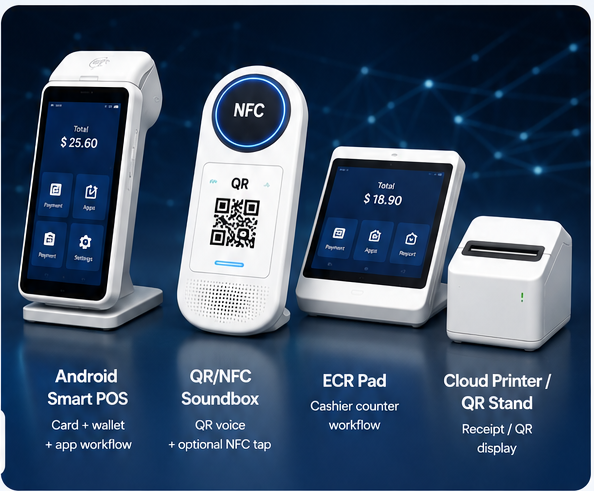
Merchant device portfolio at a glance
For non-technical decision makers, form factor matters. Android POS, QR/NFC soundbox, ECR pad and cloud printer / QR stand solve different merchant acceptance problems and should not be treated as one generic “payment device.”
Neutral render for visual explanation only. Final product appearance, branding, certification and software scope depend on the customer project.
1. Executive decision map
Merchant acquiring teams often ask which device is “best.” That is the wrong starting question. The better question is: which device is right for this merchant segment and payment behavior?
Start with merchant reality, not device preference
Each device solves a different problem. A soundbox solves confirmation and trust. POS solves card and app workflows. ECR pad solves cashier operations. Tap to Phone reduces hardware dependence where NFC-ready smartphones are common.
Payment rail
Card, QR, wallet, account-to-account, NFC or mixed acceptance.
Merchant size
Micro stall, shop, pharmacy, supermarket, agent or delivery.
Workflow
Counter, mobile, cashier, logistics, agent banking or bill payment.
Support model
Swap, repair, remote configuration, TMS and local agent support.
Unit economics
Device subsidy, rental, transaction margin, merchant lifetime value.
Payment soundbox has three possible roles
In a basic acquiring project, soundbox is just a QR confirmation device. In a platform strategy, it can become a physical access point connecting merchants, wallets, agents and community users.
QR payment carrier
The soundbox gives QR payment a physical presence at the merchant site: QR display, voice confirmation, local language prompts and transaction trust.
Low-cost POS substitute
For merchants that do not yet need full card acceptance or app workflows, soundbox can cover payment confirmation at a lower device and service cost.
Platform access point
For wallet, agent, community or marketplace models, the device can become a physical access point for users to pay, confirm, cash-in/out, receive prompts or interact with the ecosystem.
“A soundbox is not only a speaker. In the right model, it can be the lowest-cost physical access point for a digital payment ecosystem.”
TermBridge view for merchant rollouts
2. Why the most advanced device is not always the first device
In many emerging markets, payment companies want to expand merchant acceptance quickly. It is tempting to push full Android POS everywhere because the device looks more capable. But capability does not always equal adoption.
A micro merchant may not need card acceptance, receipt printing or a full app ecosystem on day one. They may only need a low-cost way to accept QR payments and hear instant confirmation. A supermarket or pharmacy, on the other hand, may need a counter device, receipts, scanner or weighing-scale integration. A mobile sales agent may benefit from Tap to Phone if smartphone and NFC conditions are ready.
The right strategy is often a portfolio strategy, not a one-device strategy.
3. NFC Soundbox: QR voice confirmation plus tap interface
Some soundbox designs can add an NFC tap area on top of the QR and voice-confirmation function. This creates a more flexible merchant device: QR users can scan, while wallet or card users may tap depending on the payment model, certification status and acquiring environment.
NFC Soundbox concept
For website use, avoid showing Alipay or any third-party payment brand on the product image. Use a neutral TermBridge / partner-branded mockup, QR placeholder and generic “Tap / Scan / Confirm” language.
Static or dynamic QR display with voice confirmation and merchant trust.
NFC can support closed-loop wallet tap, account-based tap, or card acceptance depending on the ecosystem.
SIM / 4G connectivity can support remote configuration, update and transaction notification.
Local-language prompts can help merchants and users understand payment status.
Certification boundary: card acceptance vs wallet-to-wallet
This distinction is important. NFC hardware does not automatically mean global card acceptance.
If it accepts open-loop cards
When the device is used as a contactless card acceptance terminal for Visa, Mastercard or other EMV card schemes, certification and scheme/acquirer approval become part of the project scope.
- EMV contactless / kernel approval may be required
- Acquirer and payment scheme rules apply
- Security, transaction routing and acceptance testing must be scoped
If it is wallet-to-wallet / closed-loop
If the device is used only inside a wallet, community or account-to-account platform, the EMV card-terminal requirement may not apply in the same way. The project still needs wallet-platform security, local regulation, transaction records and operator approval.
- No claim of EMV card acceptance by default
- Wallet/platform owner defines rules
- Regulator, bank or processor review may still be required
4. Soundbox as a platform access point
Your Vince / HelloPass discussion shows a deeper use case: a device at the merchant or community point is not just for accepting one payment. It can become the physical bridge between a wallet platform, local merchants, communities, farmers, agents and third-party applications.
In that model, the soundbox is valuable because it is simple, low-cost, always visible at the merchant site, and can potentially support SIM connectivity, remote configuration, local-language voice prompts and platform-specific payment confirmation. This makes it different from a pure QR sticker and different from a full POS terminal.
Platform access point logic
The device becomes a bridge between the digital platform and offline merchant/community locations.
Strategic note: this does not mean every soundbox project should become a platform project. It means TermBridge should evaluate whether the customer is only solving payment confirmation, replacing POS cost, or building an offline access layer for a larger wallet / community / marketplace ecosystem.
5. Device comparison: what each device is really for
| Device type | Best fit | Strength | Main risk | TermBridge view |
|---|---|---|---|---|
| Android POS | Card acceptance, agent banking, bill payment, app-based workflows | Flexible, powerful and familiar for payment networks | Higher cost, certification, app integration and maintenance burden | Best for higher-value or multi-service merchants |
| QR/NFC Payment Soundbox | QR acceptance, wallet platforms, micro merchants, agent/community access points; optional tap interface | Low-cost confirmation, trust, local language audio, SIM connectivity, remote configuration and optional NFC interaction | NFC does not mean EMV card acceptance by default; certification depends on use case | Best for QR-led coverage, tap interaction and platform access |
| ECR Pad | Retail counters, post office counters, pharmacy, cashier points | Fits fixed-location cashier workflow and peripheral connection | Requires clearer counter-process and integration planning | Best for structured counter operations |
| QR Stand / Static QR | Very small merchants and ultra-low-cost onboarding | Lowest hardware cost and easiest distribution | Weak confirmation and higher merchant trust gap | Best as first-layer acceptance |
| Tap to Phone / SoftPOS | Merchants with NFC smartphones and contactless card/wallet users | Reduces dedicated hardware dependence | Depends on smartphone quality, OS, NFC readiness and acquirer app | Best where NFC ecosystem is ready |
6. Match the device to merchant segment
A good merchant device strategy starts by dividing the market into segments instead of treating every merchant the same.
Micro merchant / street shop
Likely fit: QR stand + payment soundbox. The priority is low cost, trust and simple payment confirmation.
Small store / convenience shop
Likely fit: Soundbox, entry POS or Tap to Phone depending on card and wallet behavior.
Supermarket / pharmacy
Likely fit: Android POS or ECR pad. The priority is cashier workflow, receipt, scanner or peripheral connection.
Agent / community payment point
Likely fit: Soundbox, Android POS or dedicated agent terminal. The priority is trust, wallet access, payment confirmation and transaction record.
Delivery / logistics
Likely fit: Mobile POS, handheld terminal or Tap to Phone. The priority is portability, battery, connectivity and scanning.
Farmers / cooperatives / associations
Likely fit: Soundbox plus platform app or agent device. The priority is offline trust, local language prompts, cash/payment bridge and community access.
7. Emerging-market rollout logic
In emerging markets, device selection is a rollout economics problem. The technical device is only one part of the equation.
Device cost vs rollout friction
A device that looks powerful on paper may fail if merchant training, connectivity, repair and app integration are not ready.
What buyers see first
What decides rollout success
Payment soundboxes became popular in QR-heavy markets because they solve a very specific merchant pain point: real-time payment confirmation without requiring the merchant to check a phone screen after every transaction. In wallet/community platform models, they can also become the low-cost offline access point where users, agents and merchants interact with the digital ecosystem. POS terminals remain necessary where cards, receipts, apps or multi-service transactions matter. ECR pads make sense when the payment device is part of a fixed counter workflow.
8. Common mistakes in merchant device rollouts
- Pushing full POS too early: when the merchant only needs QR confirmation and basic trust.
- Using soundbox where card acceptance is required: soundbox is excellent for QR confirmation and platform access, but not a full card terminal replacement unless NFC/card features are built into the device model.
- Ignoring app and backend integration: even simple devices need provisioning, merchant binding, SIM/data logic, notification rules and platform integration.
- Ignoring support economics: low device cost can be lost if repair, swap and remote configuration are not planned.
- Copying another country’s model blindly: India’s QR/soundbox model is useful, but each country has different payment rails, merchant behavior and regulator expectations.
Commercial warning: a device portfolio should follow merchant segmentation. If every merchant receives the same device, the rollout may waste subsidy on low-value users and under-serve high-value merchants.
9. Merchant device selection checklist
Use this checklist before choosing POS, soundbox, ECR pad, QR stand or Tap to Phone for a rollout.
Which payment rails are required: card, QR, wallet-to-wallet, account-to-account, NFC tap or mixed?
Which merchant segment is the first target: micro, small shop, retail counter, agent or delivery?
Is NFC used for open-loop card acceptance, or only wallet-to-wallet / closed-loop tap interaction?
Is the device only for payment confirmation, or also a physical access point for wallet/community/platform users?
Who owns merchant onboarding, KYC, device binding, wallet/app integration and transaction notification logic?
What connectivity and power conditions exist in the field?
What is the repair, swap, spare-parts and remote configuration model?
Is the device subsidized, rented, sold or bundled with merchant services?
What is the target unit economics: acquisition cost, usage, revenue and retention?
10. Where to go next
This guide supports merchant acceptance, payment terminal and light-device rollout discussions. If you are evaluating a specific country or partner strategy, review the pages below before sending an RFQ.
Sources and reference notes
This guide is based on public industry references, TermBridge’s project-scoping logic and field conversations around wallet/community payment platforms. Public references include NFC Forum materials explaining NFC as the technology behind tap-to-pay contactless payment, Visa materials describing Tap to Phone as a way for merchants to accept contactless payments on NFC-enabled smartphones, and public payment-industry materials describing soundbox devices as real-time audio confirmation tools for QR or account-based payments. The platform-access-point framing is a strategic project interpretation, not a claim that every soundbox includes wallet, cash-in/out, NFC card acceptance or marketplace functions by default. If NFC is used for open-loop card acceptance, EMV/contactless approval, scheme/acquirer rules and security evaluation may become part of the project scope. If NFC is used only inside a closed-loop wallet-to-wallet model, EMV card-terminal requirements may not apply in the same way, but local regulation, bank/processor approval and platform security still need review. Final device strategy should be reviewed by the payment scheme, acquirer, bank, processor and local implementation partners.
Planning a POS, QR/NFC soundbox or ECR pad rollout?
Share your merchant segment, payment rails, target quantity, certification needs, app ownership and local support model. TermBridge can help map the right device mix before quotation.
Scope a Merchant Device Rollout →